Full Mouth Dental Implants: A Houston Guide
·
★ 4.7 · 1,000+ five-star reviews · Board-certified specialists · Open Saturdays
Full mouth dental implants replace an entire arch of missing or failing teeth with a fixed set anchored to four to six implants, or with a denture that snaps onto implants instead of resting on the gum. At Omega Dental Specialists in Midtown Houston, both are priced per arch, and the implant-supported denture costs less than the fixed version. This guide covers what the treatment involves, who it suits, and what the months actually look like.
Seen in Midtown Houston, Saturday hours: Book an appointment · (713) 322-7474 · Full Mouth Dental Implants in Houston
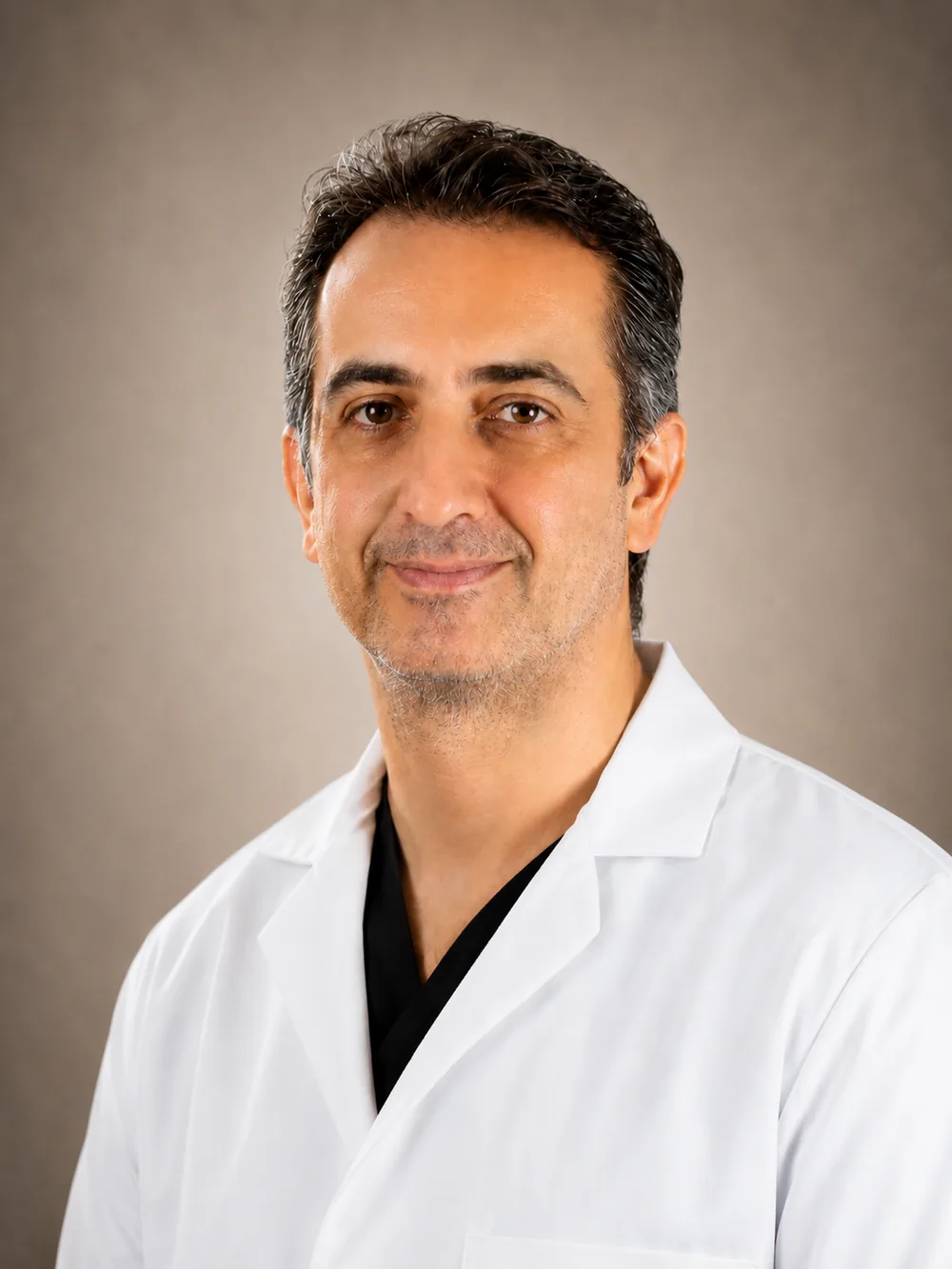
Medically reviewed by Dr. Pedram Bohluli, DDS, MS, PhD — Endodontist
Reviewed August 29, 2026
At Omega, Dr. Jonathan Rosenstein, board-certified oral & maxillofacial surgeon (ABOMS), handles full mouth dental implants.
What full mouth implants actually are
The phrase covers two quite different treatments, and knowing which one is being discussed changes everything about cost and daily life.
A fixed full arch, usually called All-on-4 or All-on-6, is a single bridge of teeth screwed onto four to six implants. It does not come out. You clean around and under it, and only a dentist removes it. It is the larger case, and the more expensive of the two.
An implant-supported denture, sometimes called an overdenture, is a denture with attachments underneath that clip onto two to four implants. You take it out to clean it, and it snaps back in. It holds securely rather than shifting, which is the entire point. It uses fewer implants and costs substantially less.
Both replace a whole arch. Both are anchored in bone rather than resting on gum. What differs is whether the teeth come out, how many implants are needed, and therefore how much bone you need and how much it costs.
Neither is "all your teeth" unless you treat both arches. Pricing is per arch, and this is the most common misreading of a full-arch quote from anywhere. When you're ready for numbers, full mouth dental implants in Houston carries the published fees.
Who full-arch treatment suits
The usual candidate is someone whose teeth are failing rather than someone with one problem tooth. Advanced periodontal disease across a whole arch, widespread decay, or a long-standing denture that has never fitted well.
The critical question is bone. Four to six implants need enough bone volume in the right positions, and this is where long-term denture wearers are often surprised. A conventional denture rests on the ridge and does nothing to stimulate the bone underneath, so the ridge continues resorbing under it for years (see Cleveland Clinic's guide to dental implants). The CBCT scan at your consultation measures exactly what is there.
Insufficient bone is usually a step rather than a stop. Grafting rebuilds it, adding cost and several months. An implant denture needs fewer implants and less bone than a fixed arch, so it is frequently the answer when a fixed arch would need extensive grafting first.
Uncontrolled diabetes, heavy smoking, past radiation to the head or neck and certain bone density medications all affect healing. None is an automatic exclusion, and where they apply we coordinate with your physician rather than deciding alone.
What the treatment involves, stage by stage
Consultation and planning first. A CBCT scan, photographs, an examination of what remains, and a written plan with the fee before anything begins.
Extractions and site preparation next, where teeth still need removing. Extractions are quoted at your CBCT consultation, case by case. For a fixed arch these are often done in the same visit as implant placement rather than as a separate surgery.
Implant placement is the surgical day. Four to six implants per arch, placed by an oral and maxillofacial surgeon or our periodontist, usually under IV sedation along with local anesthetic. For a fixed arch, a temporary set of teeth usually goes in the same day when the implants are stable enough, which is what "teeth in a day" refers to.
Integration follows, four to six months while bone grows around the implants. You wear the temporary throughout. This is the long stretch, and it is not optional: loading implants before they have integrated is how they fail.
The final prosthesis is fitted at the end. Impressions or a scan, then the definitive teeth, checked for bite, fit and appearance before final placement.
Recovery, and the first few weeks
The first three to five days are the significant ones, and full-arch surgery is more than a single implant. Expect swelling, bruising and soreness, managed with ice, rest and the medication we send home with you. Most people take several days off rather than one.
Soft food for the first weeks, and this genuinely matters. The temporary prosthesis is not built for the forces a final one handles, and the implants beneath it are integrating. We will give you a specific progression rather than a vague instruction.
Do not smoke while the sites heal. It is one of the clearest risk factors for early implant failure, and full-arch cases have more sites that can fail.
Speech takes a short adjustment, usually a week or two, and reading aloud speeds it up more than people expect.
Call us rather than waiting if pain is climbing after day three, if you have a fever, or if the temporary feels loose. We keep same-day emergency slots on weekdays.
Living with a full arch afterward
This is the part that gets least attention in full-arch marketing and matters most over a decade.
Cleaning underneath a fixed arch takes technique. There is a small gap between the prosthesis and the gum, and it needs a water flosser and specialised floss daily. Neglected, the tissue around the implants develops peri-implantitis, which is quiet early and expensive late.
You will need professional maintenance on a schedule, and for a fixed arch that periodically means removing the prosthesis to clean beneath it properly. Ask any provider what that costs and how often, because it is a real ongoing figure and it is rarely volunteered.
The prosthesis itself wears. Acrylic teeth need replacing sooner than zirconia, and the two differ substantially in cost. Ask what yours is made of and what replacement costs before you sign anything. Our standard final bridge is a hybrid; zirconia costs more and is quoted at your consultation.
An implant denture is simpler here: it comes out, so you clean it like a denture and clean the implants directly.
None of this is a reason not to do it. It is the honest version of what you are taking on.
Fixed arch or implant denture
The two sit far apart in price, and the more expensive option is not automatically the better one for you.
A fixed arch gives the highest biting force and the closest feel to natural teeth. Nothing comes out. It needs more implants and therefore more bone, and it demands the cleaning routine above.
An implant denture needs fewer implants, works with less bone, costs substantially less, and is far easier to keep clean. It comes out, which some people mind and others prefer. Compared with a conventional denture, the difference in stability is the thing patients notice immediately.
For a great many people the implant denture is genuinely the better fit rather than a downgrade, and we would rather say that than sell the larger case. What the right answer depends on is your bone, your budget and how you feel about removing your teeth at night.
More on each: All-on-4 and snap-on implant dentures. Before you settle on a fixed arch, read the common problems with All-on-4 too.
What it costs, and how people pay
The average cost of full mouth dental implants in Houston depends less on the office than on the scope of the quote: one arch or both, the final prosthesis or only the surgery, and whether extractions, grafting and sedation sit inside the number. A fixed arch is the larger investment; an implant-supported denture costs less. Extractions, bone grafting, IV sedation and a zirconia upgrade are quoted per case, in writing, and the CBCT scan is taken at consultation. For today's exact fees, call (713) 322-7474.
Whether insurance contributes depends entirely on your policy, and annual maximums are the real constraint. They cap what a plan pays in a year regardless of treatment cost, and they are modest next to the price of full-arch work. Some plans exclude implants and pay toward a conventional denture instead. We verify your specific benefit with your insurer before treatment, at no charge, and give you your share in writing.
Because full-arch treatment is staged across months anyway, it can often be staged across two plan years, which brings two annual maximums and two FSA years to bear instead of one. Raise it at the consultation.
Cherry, Affirm and Sunbit spread the balance monthly, with 0% APR plans available through Affirm and Cherry for those who qualify. On a figure this size, ask for the total and the term together rather than the monthly payment. Full detail on the cost breakdown and payment options.
Full-arch treatment in Midtown Houston
Surgery is performed by our oral and maxillofacial surgeons or our periodontist. Dr. Jonathan Rosenstein is board certified and a Diplomate of the American Board of Oral and Maxillofacial Surgery. Dr. Edmund Watkins also practices oral and maxillofacial surgery here. Our periodontist, Dr. Shirin Farhadian, is board certified by the American Board of Periodontology and places full-arch implants too. The teeth are designed and fitted by our prosthodontist, Dr. Nisa Dadjoo, or by Dr. Mohsen Khobyari, who has restored more than 10,000 implants over more than two decades.
All of them work in the same building, which for full-arch cases is the practical difference. The surgeon places implants where the final prosthesis needs them because the person building it is down the hall.
We are at 106 W Gray Street in Midtown, between Downtown and the Texas Medical Center, with parking on site. Patients come from Montrose, River Oaks, the Heights, EaDo and the Museum District. Monday to Friday 9 to 5, Saturday 9 to 3.
The consultation includes the scan. If you are holding a quote from elsewhere, bring it. How to choose an All-on-4 provider lists what to check in it, and our comparison with ClearChoice and other implant centers covers that route. Call (713) 322-7474 or book online.
Frequently asked
What are full mouth dental implants?
The term covers two treatments. A fixed full arch, All-on-4 or All-on-6, is a bridge of teeth screwed onto four to six implants that does not come out. An implant-supported denture clips onto two to four implants and comes out for cleaning, for less than a fixed arch. Both are priced per arch, so treating upper and lower doubles the figure.
How long does full mouth implant treatment take?
Usually four to six months from surgery to the final prosthesis, because the implants need that time to integrate with bone before they can carry definitive teeth. For a fixed arch, a temporary set usually goes in the same day as surgery, when the implants are stable enough, so you are not without teeth during the wait. If extractions or bone grafting are needed first, add a healing period before that starts.
Am I a candidate for full mouth dental implants?
The deciding factor is bone volume, which the CBCT scan at your consultation measures directly. Long-term denture wearers often have less than expected, because a denture resting on the ridge does not stimulate the bone beneath it. Insufficient bone is usually a step rather than a stop, since grafting rebuilds it. An implant denture needs fewer implants and less bone than a fixed arch.
Can you get all your teeth done in one day?
The surgery and a temporary set of teeth are commonly done in one day for a fixed arch when the implants are stable enough, which is what same-day teeth refers to. The final prosthesis is not placed that day. It comes four to six months later, once the implants have integrated with bone, because loading them before that is how implants fail.
How do you clean full mouth dental implants?
A fixed arch does not come out, so you clean around and under it daily with a water flosser and specialised floss, and it needs professional maintenance on a schedule that periodically involves removing the prosthesis. An implant-supported denture comes out, so you clean it like a denture and clean the implants directly. Ask any provider what ongoing maintenance costs, because it is a real recurring figure.
Do full mouth implants look natural?
A well made full-arch prosthesis is designed around your face, not just your gums, and shade, tooth shape and lip support are all set before the final teeth are made. You approve the appearance at the try-in stage rather than seeing it for the first time when it is fitted. Material matters here too: zirconia and acrylic differ in appearance as well as longevity.
Is a full arch better than an implant denture?
Not automatically. A fixed arch gives higher biting force and stays in the mouth, but needs more implants, more bone and a demanding cleaning routine, and it is the more expensive of the two. An implant denture costs substantially less, needs less bone, and is easier to keep clean, though it comes out at night. For many patients it genuinely fits better rather than being a downgrade.