Periodontist in Houston for gum disease and grafts
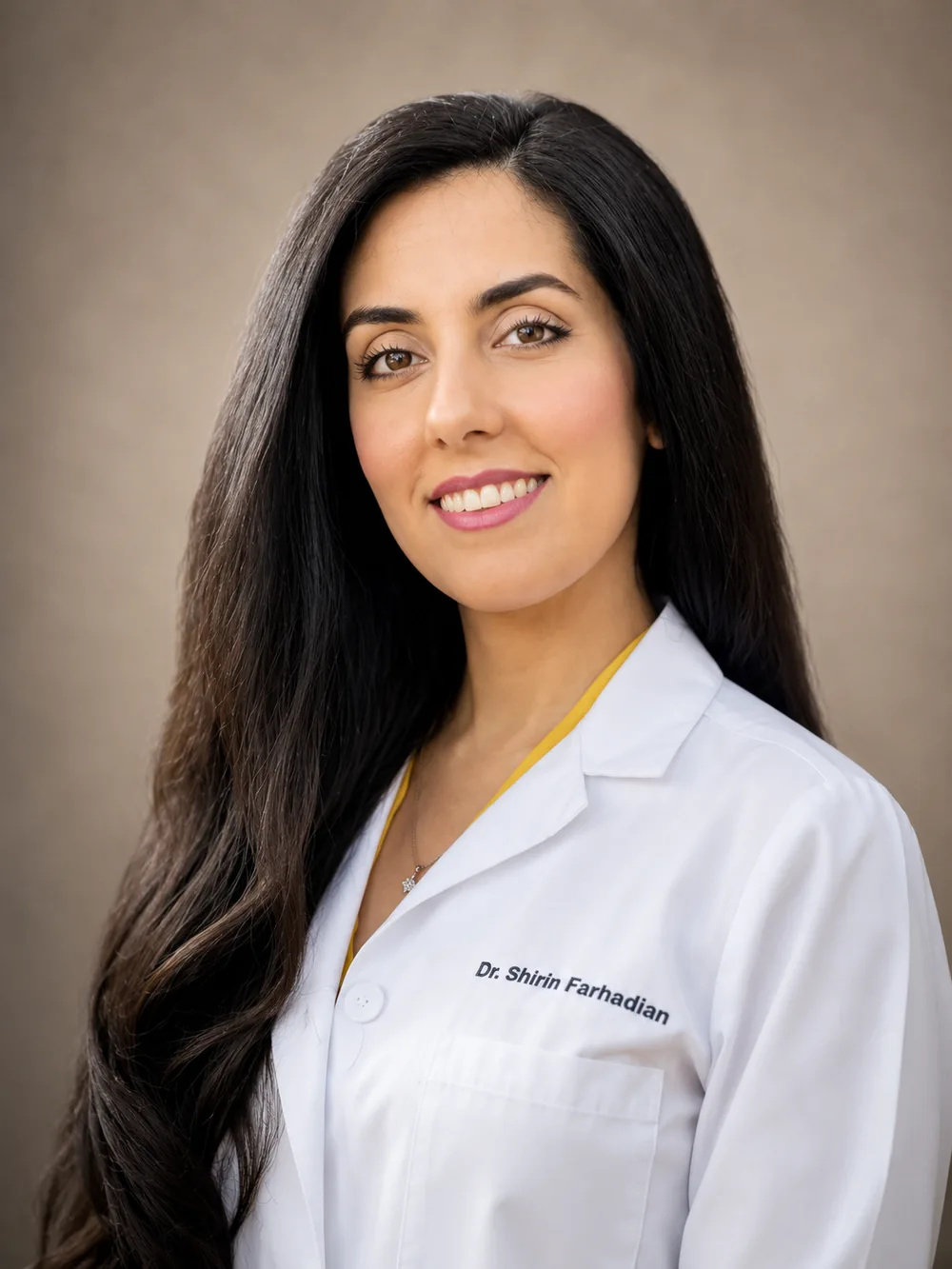
You can book a periodontist directly here, without a referral from another dentist. Dr. Shirin Farhadian, board certified, treats gum disease at every stage, rebuilds receded gums, and prepares implant sites, with every fee published below and put in writing before treatment.
You do not need a referral
This is the question that stops most people, so it goes first.
You can make an appointment with a periodontist yourself. No referral letter, no permission from a general dentist, no waiting for someone else to decide your gums are bad enough. If you have been told you have gum disease, or you have been watching your gums bleed for a year and nobody has measured anything, you can call us directly.
If you do have a regular dentist, that relationship stays intact. We are not asking you to change dentists. Periodontal treatment is a course of work that finishes, and your cleanings and fillings can carry on where they always have. We will send your records back so whoever sees you next knows exactly what was done.
If you do not have a regular dentist, that is fine too. We can do all of it here.
What you should not do is wait for a referral that nobody is going to write. Bone lost to gum disease does not come back, and the difference between an early case and a late one is mostly how long it went unmeasured.
What gum disease is actually doing
Gum disease runs on a simple mechanism. Bacteria collect where the gum meets the tooth, the tissue becomes inflamed, and the seal between gum and tooth starts to pull away. That gap is a pocket. Once a pocket forms it traps more bacteria, which deepens the pocket, which traps more bacteria.
At the gingivitis stage only the soft tissue is involved, and it is genuinely reversible. Once it becomes periodontitis, the body starts losing the bone that anchors the tooth. Bone does not grow back on its own, which is why timing matters here more than almost anywhere else in dentistry.
We measure this rather than eyeball it. A periodontal probe records the depth of each pocket at six points around every tooth, one to three millimeters being healthy, and X rays show how much bone is actually left. You will see the chart.
The uncomfortable part is that early and moderate gum disease usually does not hurt. Bleeding when you brush is often the only warning you get, and it is very easy to decide that bleeding is normal. It is not.
Why half of this is invisible to you
Gum disease is usually painless until it is advanced, which is exactly what makes it dangerous. Red or swollen gums, bleeding when you brush, breath that stays bad, and gums pulling away from the teeth are the visible signs, but the destructive part, bone loss inside the pocket, happens where you cannot see or feel it.
That is why the probe matters more than the mirror. A healthy gum groove measures one to three millimeters; anything past four tells us the disease is active. We chart every tooth, so treatment targets the pockets that need it instead of guessing, and so the next visit can measure whether the numbers are actually improving.
Gum health decides more than gums
The condition of your gums sets the ceiling on almost everything else in dentistry. A history of gum disease raises the risk of implant failure and peri-implantitis, which is why active infection gets treated before an implant is placed here, not worked around. Orthodontic movement through inflamed tissue goes badly, so braces and aligner cases start with healthy gums too. And the bone that periodontitis destroys is the same bone a denture or a bridge needs to rest on.
Treating gum disease first is not upselling; it is sequencing. Every specialty in this building depends on the foundation Dr. Farhadian looks after, which is why her chair is often the first stop in a bigger plan.
When a cleaning is not going to fix it
A standard cleaning at $120 polishes what is above the gum line. It does not reach inside a pocket, and neither does brushing at home. If the problem is below the gum line, regular cleanings will keep coming up short no matter how diligently you attend.
Worth getting measured if any of these apply:
• Your gums bleed when you brush or floss.
• They have pulled back, so teeth look longer or feel sharp and sensitive at the root.
• Persistent bad breath or a bad taste that brushing does not shift.
• Teeth have started to shift, spread apart, or feel loose.
• You were told you have pockets of five millimeters or more.
• You had a deep cleaning already and the numbers did not improve.
It is also worth a visit before other work rather than after. Implants, orthodontics and veneers all sit on top of your gums and bone, so the periodontal exam is often the first appointment rather than the last one.
Gum recession and grafting
Recession is the one people notice themselves, usually because a tooth looks longer than it used to or reacts to cold in a way it did not before.
It is worth knowing that recession and gum disease are not the same thing. Gums recede from periodontal disease, but also from brushing too hard with a firm brush, from grinding, from a tooth sitting outside the arch with thin bone over the root, and sometimes from having naturally thin tissue. The treatment is different depending on which it is, which is why the cause gets identified before anything is grafted.
A graft at $1,200 covers the exposed root with tissue. That protects the root surface, which is softer than enamel and decays more readily, reduces the cold sensitivity, and stops the recession from continuing. If it is left alone the root keeps being exposed, and root decay at the gum line is a difficult thing to restore.
Not every recession needs grafting. Stable recession with no sensitivity, no decay risk and no continuing loss can reasonably be watched and measured. We would rather monitor something than operate on it, and the way to know is a baseline measurement you can compare against next year.
More detail on the procedure and the fee in our guide to gum surgery cost in Houston and on receding gums.
What treatment feels like
Everything here is done with local anesthetic, and sedation is available if dental work makes you anxious. Tell us at the consultation rather than on the day, so it can be arranged properly.
After scaling and root planing, expect tenderness and some cold sensitivity for a few days. Soft food helps, and the sensitivity usually settles within a couple of weeks as the tissue tightens back against the root.
After a gum graft, plan on one to two weeks of careful eating, no brushing directly on the site, and a prescribed rinse instead. If tissue was taken from your palate, that donor site is often the sorest part rather than the graft itself, and it is worth knowing that in advance.
We bring you back to re-measure the pockets several weeks later, because the point of treatment is a number that improved, not a mouth that feels cleaner. Feeling better and being better are not the same, and only one of them is measurable.
Why it comes back, and what maintenance really is
Periodontitis is managed, not cured. That sentence does more work than anything else on this page.
What treatment does is reset the situation. It removes the deposit, closes the pockets it can close, and gives the tissue a chance to reattach. What it cannot do is change the fact that you are a person whose gums responded to bacteria this way once and will again.
So most periodontal patients move to maintenance visits every three or four months instead of every six. That interval is not upselling. It comes from how quickly the bacterial population below the gum line re-establishes itself, which is faster than six months in someone with a periodontal history.
The patients who hold their results keep that schedule. The ones who go back to twice a year, and to skipping the floss most nights, are the ones we see again in four years with the same pockets and less bone than before.
Smoking works against the result more than anything else on the list. Uncontrolled diabetes and heavy grinding are next. None of that is a lecture, it is just what determines whether the money you spend on treatment stays spent once.
Periodontal care in Midtown Houston
Gum cases reach us from across Houston, often after bleeding gums were treated as a cleaning problem for years before anyone put a probe in and called it periodontal disease.
Dr. Shirin Farhadian is a board certified periodontist and a Diplomate of the American Board of Periodontology, completed her residency at Saint Louis University, and holds a Texas Level 3 sedation permit. Gum and bone work is her specialty rather than something the practice also does.
Because the oral surgeons and the restorative team are in the same building, a case that starts as a graft and ends as an implant stays with one team and one record. Nobody has to re-explain their history in a second office.
We are at 106 W Gray Street in Midtown, between Downtown and the Texas Medical Center, with parking on site. People come to us from Montrose, River Oaks, the Heights, EaDo and the Museum District. Open Monday to Friday 9 to 5 and Saturday 9 to 3.
Start with the exam. Call for today's fee, and if you have insurance, we file it for you. Pocket depths get measured at six points around every tooth and compared against your X rays, and you will see the chart yourself. Call (713) 322-7474 or book online.
Treatments & pricing
Deep cleaning (scaling & root planing)
Removes plaque and bacteria below the gumline. The first step in reversing early gum disease.
Gum graft
Restores receded gum tissue. Modern techniques use minimal donor tissue with same-day recovery.
Crown lengthening
Reshapes gum + bone to expose more tooth. Used for cosmetic gummy-smile correction or to save a damaged tooth.
Prices are estimates for self-pay patients before insurance. What your own plan contributes depends on the policy, and we verify it with your insurer before treatment. Financing through Cherry, Affirm and Sunbit for qualifying applicants, subject to the lender's approval.
Frequently asked
Do I need a referral to see a periodontist?
No. You can book a periodontist directly at Omega Dental Specialists without a referral from a general dentist. If you already have a dentist, that relationship stays as it is and we send your records back afterward so your regular care carries on uninterrupted. If you do not have one, we can handle everything here.
How much does a periodontist cost in Houston?
Scaling and root planing, $400 per quadrant, is the usual starting point and very often the only step. Your mouth is numbed and divided into four quadrants, and we clean the hardened deposit off the root surfaces inside the pockets so the tissue can reattach. Most cases are handled here.
A gum graft, $1,200, addresses recession. Tissue is used to cover an exposed root, which protects it from decay, reduces cold sensitivity and stops the recession advancing.
Crown lengthening, $800, reshapes gum and bone to expose more of the tooth, either so a crown or filling has something solid to hold, or to even out a gummy smile.
Pockets that stay deep after scaling and root planing need more than cleaning. What that involves depends on how much bone has been lost around the tooth, so it is decided from your measurements and quoted in writing before anything is scheduled.
Which of these you need comes from the chart, not from a package. If the answer is the $400 cleaning and nothing else, that is what we will tell you.
Does insurance cover a periodontist?
Two things make periodontal budgeting different from other dental work.
Treatment is priced by quadrant rather than by visit, so a case affecting one corner of your mouth and a case affecting all four are very different totals. Four quadrants of scaling and root planing is $1,600. One quadrant is $400. The chart decides which you are.
And the annual maximum matters, because a full-mouth plan can sometimes be staged across two benefit years. Whether that helps depends entirely on your policy and on how urgent the case is, and it is not always the right call clinically.
On coverage, we will not tell you what your plan pays, because we do not know until we ask it. Periodontal treatment is handled differently from plan to plan, some policies treat surgical and non-surgical periodontal work under separate categories, and frequency limits on deep cleanings are common. We verify your specific benefit with your insurer before treatment and give you your own number in writing rather than a percentage.
If you have no insurance, the membership plan is $199 a year, covers your exams, cleanings and X rays, and takes 15% off our published fees for fillings, crowns, bridges, gum treatment, cosmetic work, single implants and oral surgery. Cherry, Affirm and Sunbit spread the balance monthly.
The blunt version of the arithmetic: early pockets are the least expensive this ever gets. Once bone loss costs you a tooth, you are paying $420 for the extraction and $3,900 for an implant to replace it, plus $650 for a socket-preservation graft at the extraction if the socket is damaged. Larger grafts are quoted after a CBCT scan.
How do I know if I have gum disease?
The usual signs are bleeding when you brush or floss, persistent bad breath or a bad taste, gums that look red or have pulled away so teeth appear longer, and teeth that have started to shift or feel loose. None of that is definitive on its own, because the only way to know is measurement. A periodontal probe records pocket depth around each tooth, and depths beyond three millimeters with bleeding indicate active disease.
Can gum disease be reversed?
Gingivitis, where only the soft tissue is inflamed, is genuinely reversible with proper cleaning and home care. Periodontitis is different, because by then bone has been lost and bone does not grow back on its own. What treatment does at that stage is stop the progression and stabilize what is left, which is why the earlier it is measured the more there is to save.
Is a deep cleaning the same as scaling and root planing?
Yes. Deep cleaning is the everyday term for scaling and root planing, and it is a different procedure from a regular cleaning. A regular cleaning at $120 works above the gum line. Scaling and root planing at $400 per quadrant goes below it, cleaning hardened deposit off the root surfaces inside the pockets, and is done under local anesthetic, usually across two visits.
How much does a gum graft cost in Houston?
A gum graft is $1,200 at Omega Dental Specialists in Midtown Houston. The fee covers the procedure itself, and you get your figure in writing after the exam. Not every recession needs grafting: stable recession with no sensitivity and no continuing loss can reasonably be measured and watched instead, which is a conversation worth having before anyone operates.
What happens if gum disease is left untreated?
The pockets deepen, more bone is lost around the roots, and eventually teeth loosen and are lost. Gum disease is the leading cause of tooth loss in adults and it usually does this without pain, which is why it goes unnoticed. The cost follows the same curve: a $400 quadrant of deep cleaning at the early stage, against $420 for an extraction plus $3,900 for an implant once a tooth is gone, and $650 more for a socket-preservation graft if the socket is damaged.
Related specialties
Ready to get started?
Book a consultation. We'll walk you through your options, your costs, and your timeline - no pressure.