All-on-4 vs All-on-6 Implants in Houston
·
★ 4.7 · 1,000+ five-star reviews · Board-certified specialists · Open Saturdays
At Omega Dental Specialists in Midtown Houston, All-on-4 and All-on-6 are priced the same per arch, so the choice is not about money. It is about how much bone you have, where it sits, and how hard you bite. Here is how our surgeons decide, and what each option means for you.
Seen in Midtown Houston, Saturday hours: Book an appointment · (713) 322-7474 · Dental Implants in Houston
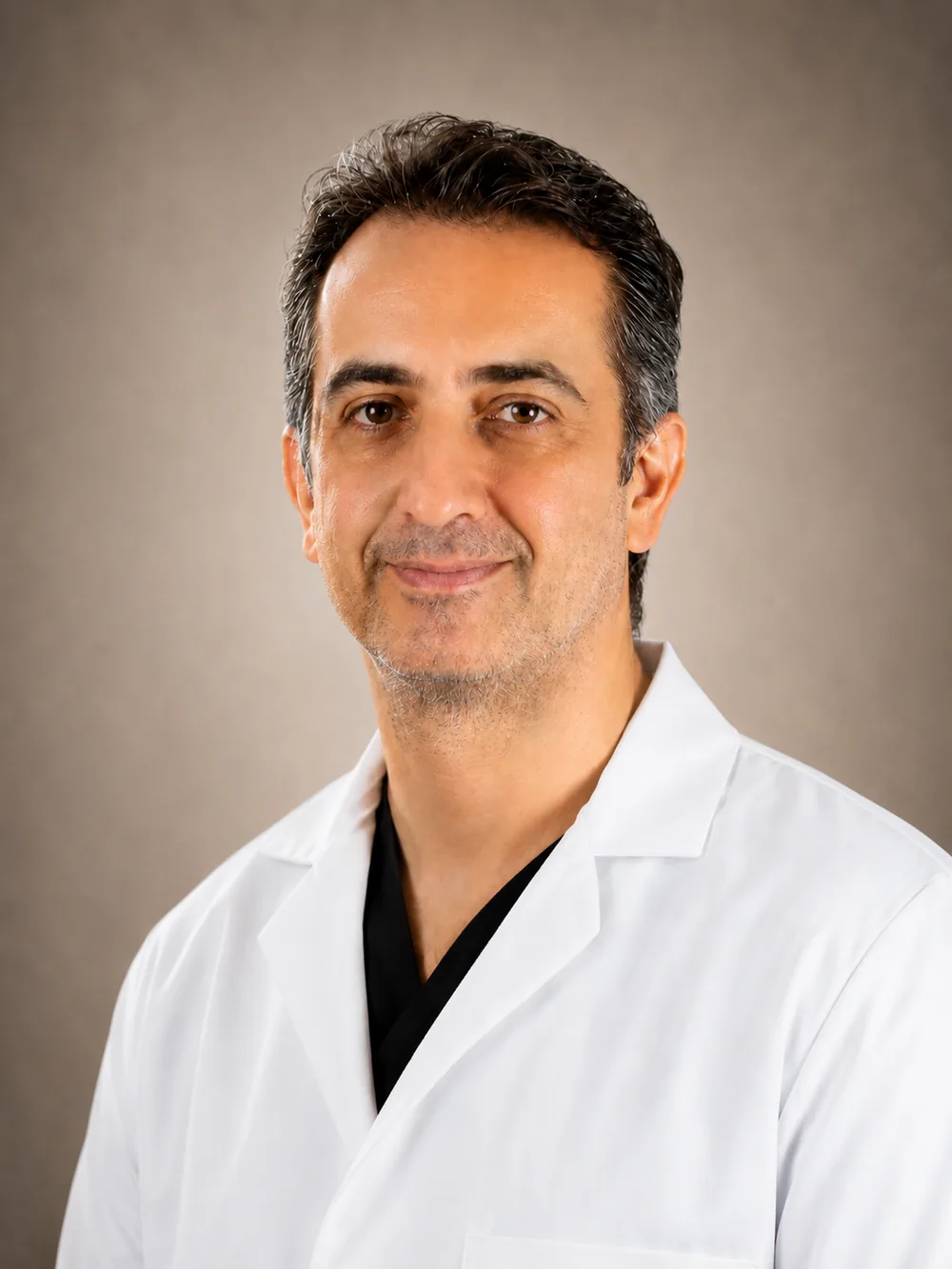
Medically reviewed by Dr. Pedram Bohluli, DDS, MS, PhD — Endodontist
Reviewed October 10, 2026
At Omega, Dr. Jonathan Rosenstein, board-certified oral & maxillofacial surgeon (ABOMS), handles dental implants.
The Short Answer
All-on-4 places four implants per arch and tilts the two back ones forward at an angle so they catch dense bone at the front of the jaw. All-on-6 places six, spread further back, and needs more bone to do it.
Lower jaws take four well, because the bone at the front of the mandible is the densest in the mouth. Upper jaws are softer, the sinus sits in the way of the back segments, and a longer bridge flexes more, so uppers are where six implants earn their keep.
Neither number is better in the abstract. A CBCT scan of your jaw settles it in about ten minutes, and that scan happens at your consultation.
What These Procedures Actually Are
An implant is a titanium post placed into the jawbone. Bone grows onto titanium and locks it in place, a process called osseointegration that takes months. For a full arch, we fit the final bridge usually four to six months after surgery.
For a full arch you do not need one implant per tooth. A fixed bridge carrying 12 to 14 teeth is anchored on four or six posts and screwed down. It does not come out at night. You do not use adhesive. You brush it, floss under it with a threader or a water flosser, and it stays put.
The procedure replaces every tooth in the arch, so any remaining teeth in that jaw come out on the day of surgery. That is a hard sentence to read if you still have some. It is also why we will not recommend a full arch to someone whose own teeth can be saved.
When Four Implants Is the Right Plan
All-on-4 suits you when:
• The arch is the lower jaw. Dense bone at the front means four angled posts hold a full bridge very reliably.
• You have already lost bone height at the back. The tilted implant design was invented specifically to avoid grafting the posterior jaw, which is why All-on-4 often means no bone graft and no extra six months of healing.
• You want fewer surgical sites. Four is less surgery, less swelling, and generally an easier first week than six.
• You have a medical reason to keep the operation short. Fewer implants means less time in the chair, which matters for patients with cardiac or other conditions.
Four implants supporting a full arch is not a compromise. It has more than two decades of clinical data behind it.
When Six Implants Is the Better Plan
All-on-6 makes more sense when:
• The arch is the upper jaw and there is enough bone to place six. Upper bone is softer, and spreading the load over six posts reduces flex across a long span.
• You are a heavy grinder, or you have a strong bite and natural teeth still opposing the bridge below. Two extra anchors take that load better.
• The bridge needs to extend further back to give you real molar chewing rather than stopping at the premolars.
• One implant later fails. With six, the bridge can often be restored on the remaining five while the site heals. With four, losing one is a bigger problem.
That last point is the one patients weigh most once they hear it.
What Full Arch Implants Cost in Houston
Full arch treatment is priced per arch, and at our Midtown office four implants and six cost the same, so the clinical decision never has to fight the financial one. Treating both arches doubles the figure, which is worth remembering when you compare quotes.
The fee covers the surgical placement, the fixed temporary bridge that usually goes in the day of surgery when the implants are stable enough, and a hybrid final bridge after healing. A zirconia bridge costs more and is quoted at your consultation. Extractions of any remaining teeth in that arch are quoted at your CBCT consultation, case by case.
Two more things can add to a plan: a bone graft where one is needed, and IV sedation, which most full-arch surgery uses. Both go on the written quote before anything begins.
If you are replacing a full arch but do not want a fixed bridge, an implant supported denture that snaps onto implants and comes out for cleaning costs less than a fixed arch. It is a genuinely different product, and for some patients it is the right one.
The average cost of full arch implants in Houston varies widely between offices, mostly because quotes differ in what they include; ours is itemized and handed to you in writing. For today's exact fee, call (713) 322-7474 or visit the All-on-4 page. If you want the fuller cost breakdown first, our full mouth implant cost guide walks through what drives the number arch by arch.
Coverage for full arch work depends entirely on your policy. We verify your benefits with your insurer before treatment and give you your share in writing. Cherry, Affirm and Sunbit spread the balance into monthly payments for qualifying applicants, and our team will show you the numbers before you commit to anything.
Surgery Day and the Six Months After
The surgery itself runs two to four hours per arch under IV sedation. Most patients remember little or nothing of it. Remaining teeth come out, the implants go in, and a fixed temporary bridge is usually attached the same day when the implants are stable enough, which is why this is sometimes called teeth in a day.
You do not leave with your final teeth.
The first week means swelling, bruising and a soft diet. Plan on a week off if your job is physical.
Soft food for the full healing period is not a suggestion. Chewing hard food on a temporary bridge is one of the few things that will genuinely cause an implant to fail before it integrates.
Usually four to six months after surgery, once the CBCT confirms integration, the final bridge is made and fitted. That is when you get back to eating normally.
Who Does This at Omega Dental Specialists
The implants here are placed by our oral and maxillofacial surgeons, Dr. Jonathan Rosenstein, board certified and a Diplomate of the American Board of Oral and Maxillofacial Surgery, and Dr. Edmund Watkins, or by our periodontist, Dr. Shirin Farhadian, board certified by the American Board of Periodontology. The teeth that go on the implants are designed and fitted by our prosthodontist, Dr. Nisa Dadjoo, or by Dr. Mohsen Khobyari, who has restored more than 10,000 implants over more than two decades.
Everything happens at 106 W Gray St in Midtown, minutes from Downtown, Montrose, River Oaks and the Texas Medical Center. Nothing gets sent to another office, which matters on a case that runs six months.
You get a 3D CBCT scan at your consultation. You will leave that appointment knowing whether four or six is right for your jaw, what it costs, and what the timeline looks like. Saturday appointments are available.
Call (713) 322-7474 or book online.
Frequently asked
Is All-on-6 better than All-on-4?
Neither is better in general. All-on-6 spreads the load across more implants and is often preferred in the upper jaw, where the bone is softer and the bridge spans further. All-on-4 uses tilted implants to anchor in dense bone at the front, which frequently avoids bone grafting and means less surgery. A CBCT scan of your jaw decides it. Both are priced the same per arch at Omega Dental Specialists in Houston.
How much do All-on-4 implants cost in Houston?
The average cost of All-on-4 in Houston depends mostly on what a quote includes, which is why headline figures are hard to compare. At Omega Dental Specialists the per-arch fee covers the surgical placement, the fixed temporary bridge that usually goes in the day of surgery when the implants are stable enough, and a hybrid final bridge after healing, and All-on-6 costs the same. Extractions, bone grafting, IV sedation and a zirconia bridge are added to the written quote where a case needs them. For today's exact fee, call (713) 322-7474.
Do I need a bone graft for All-on-4?
Often not, and that is the point of the design. Tilting the two back implants forward lets them anchor in dense bone at the front of the jaw rather than the thinner bone at the back, which is exactly where grafting is usually needed. Some patients still need a graft, which is quoted in writing before anything begins. Your CBCT scan at the consultation answers it before you commit to anything.
Can All-on-4 be done in one day?
The surgery runs two to four hours per arch under IV sedation, and a fixed temporary bridge usually goes in the same day when the implants are stable enough. The final bridge comes later, once the implants have fused to the bone, usually four to six months after surgery. Anyone promising the final bridge on day one is describing the temporary.
How long do All-on-4 implants last?
No one can promise a lifetime. A 2021 systematic review of All-on-4 reported implant survival of 94 to 98 percent at six to eleven years. The bridge on top is a wearing part: the teeth can chip and the material eventually shows its age, so plan on replacing the bridge at some point while the implants stay. Smoking and skipped maintenance visits are what shorten both.
What is the difference between All-on-4 and implant supported dentures?
An All-on-4 bridge is screwed down and you cannot take it out yourself, so you clean around it like natural teeth. An implant supported denture snaps onto implants and comes out for cleaning at night. The fixed bridge feels closer to real teeth; the snap-in version costs less and is easier to clean. We will walk you through both at the consultation.
Am I too old for full arch dental implants?
Age by itself is not a disqualifier. What matters is bone volume, healing capacity, and whether any medical conditions or medications, particularly certain bone medications, affect healing. Bring your full medication list to the consultation and the CBCT scan will show us the rest.