Full Mouth Dental Implants Cost in Houston
·
★ 4.7 · 1,000+ five-star reviews · Board-certified specialists · Open Saturdays
Full mouth replacement at Omega Dental Specialists in Midtown Houston comes down to two treatments priced per arch: a fixed full arch on four to six implants, and an implant-supported denture that snaps onto implants and costs less than the fixed version. The gap between them is the decision most people are actually making. Here is what each covers, what changes the price, and how to compare a quote from anywhere else.
Seen in Midtown Houston, Saturday hours: Book an appointment · (713) 322-7474 · Full Mouth Dental Implants in Houston
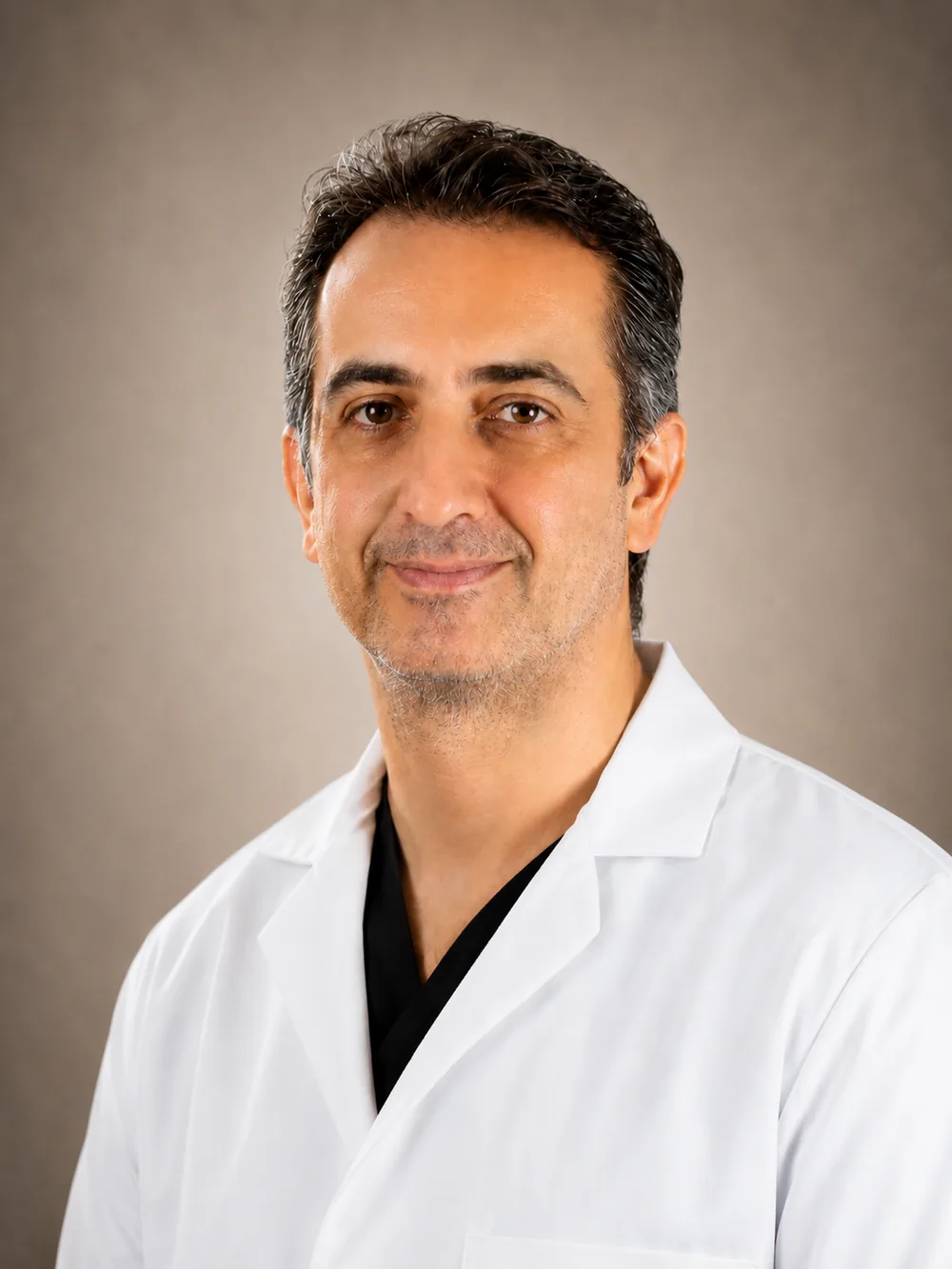
Medically reviewed by Dr. Pedram Bohluli, DDS, MS, PhD — Endodontist
Reviewed October 10, 2026
At Omega, Dr. Jonathan Rosenstein, board-certified oral & maxillofacial surgeon (ABOMS), handles full mouth dental implants.
Cost of Full Mouth Dental Implants in Houston, per Arch
Fixed All-on-4 teeth are $27,000 per arch at our Midtown Houston office, with a hybrid final bridge, in a market where the same arch runs $12,999 to $30,000 with acrylic hybrid teeth or $25,000 to $40,000 and up in zirconia, and an implant-retained snap-on denture is $17,000 per arch against a typical Houston range of $8,500 to $25,000. Full mouth replacement comes down to fixed or removable, and the price difference is large enough that it deserves stating first.
A fixed full arch, All-on-4 or All-on-6, is the premium option. The teeth are screwed onto four to six implants and stay in your mouth. You clean around them; you do not take them out. A 2021 systematic review of All-on-4 reported implant survival of 94 to 98 percent at six to eleven years.
An implant-supported denture costs less than a fixed arch. It snaps onto a smaller number of implants and comes out for cleaning. It holds far better than a conventional denture, which is the complaint it exists to solve.
Both are per arch. If you are replacing upper and lower, double the figure: $54,000 for two fixed arches, $34,000 for two snap-on arches. Houston quotes for a full mouth, both arches, run anywhere from $25,000 to $80,000 — nationally $25,000 to $70,000 — a spread that mostly comes down to fixed versus snap-on, what the final teeth are made of, and what the number includes. And since per-arch and per-mouth pricing still get compared against each other constantly, ask any competing quote directly which one it is.
Quoted separately when your case needs them, and put in writing: extractions are quoted at your CBCT consultation, case by case, a socket-preservation bone graft is $650, larger grafts are quoted at the same visit, and IV sedation, which most full-arch surgery uses, is a flat $2,000 per appointment, one fee when both arches are done together. That flat fee sits above Houston's typical $250 to $1,500, and it is flat on purpose: full-arch surgery runs long, and hourly billing — the pattern in most markets outside Houston, at $600 to $800 per hour — grows with every extra hour while ours doesn't. A zirconia bridge costs more than the hybrid and is quoted at your consultation. The 3D CBCT scan that plans it all is taken at your consultation, and today's exact fees are a call away at (713) 322-7474. For the wider market picture across every implant procedure, the dental implant cost in Houston guide puts the typical U.S. and Houston prices side by side.
| Option | Typical Houston range | Our fee |
|---|---|---|
| All-on-4 fixed teeth (per arch) | $12,999–$30,000 acrylic hybrid · $25,000–$40,000+ zirconia | $27,000 |
| Implant-retained (snap-on) denture, per arch | $8,500–$25,000 | $17,000 |
| Multi-tooth implant bridge (segment) | $3,500–$14,000 (3-unit) | $9,000 |
| Both arches (upper + lower) | $25,000–$80,000 | $54,000 fixed / $34,000 snap-on |
Every fee is itemized in writing before you commit: (713) 322-7474.
All-on-4 Cost in Houston: Acrylic Hybrid vs Zirconia
Houston full-arch quotes don't scatter evenly across one range. They cluster in two bands, because there are really two products sharing the name All-on-4, and the difference is what the final teeth are made of.
• Acrylic hybrid (acrylic teeth on a supporting frame): $12,999 to $30,000 per arch in Houston, averaging $19,499 to $25,000. Nationally, $11,640 to $27,500, averaging $15,000 to $20,680.
• Monolithic zirconia: $25,000 to $40,000 and up per arch in Houston, averaging $27,000 to $30,000. Nationally, $25,000 to $38,000, averaging around $30,000.
Acrylic costs less up front, but it wears and stains sooner, and repairs get more common over the years. Zirconia is milled as one solid piece, holds up better against wear and staining, and costs more. Neither is wrong; they are different purchases, which is why two honest Houston quotes for "All-on-4" can sit many thousands of dollars apart.
So when you compare our $27,000 arch against any other number, ask both offices the same two questions: what are the final teeth made of, and what does a replacement cost. Ours is a hybrid arch, and zirconia is a quoted upgrade. Ask us both at your CBCT consultation — you leave with a written plan that itemizes your treatment and fees.
One more piece of context worth having. A February 2026 survey of 278 practices across six US metros in Dental Economics found Houston the least expensive of the six major implant markets it studied — the median single-implant fee here is $3,665 against $4,000 nationally — and found implants placed by specialists ran a national median of $3,400 against $4,800 when placed by general dentists. Those are single-implant fees, so they say nothing about what a full arch should cost or whether a surgeon-placed arch costs more. When a Houston full-arch quote comes in high, look first at the material of the final teeth and what the number includes.
What Affects the Cost of Full Mouth Dental Implants?
Less than people expect, because the components are standard. What varies is the mouth.
Bone volume is the main variable. Full-arch implants need enough bone in the right places to anchor four to six posts, and long-term denture wearers often have less than they assume, because a denture sitting on a ridge does nothing to stimulate the bone underneath it. In nine years of records from a nationwide dental service in Israel, about one implant patient in three (17,600 of 53,874) had bone grafted during the implant surgery itself. Grafting typically adds $500 to $3,000 to a case — and, more importantly, months.
How many teeth still need removing. Extractions are quoted at your CBCT consultation, case by case, and a mouth of failing teeth adds up before the implants begin.
The material of the final prosthesis. Acrylic and zirconia differ substantially in longevity and in replacement cost, and this is the single most under-asked question in full-arch quoting. Ask what yours is made of and what a replacement costs.
Whether both arches are being treated, and whether they are treated together or in stages. Staging across two plan years lets two annual insurance maximums and two FSA years apply to one course of treatment. Say so at the consultation if that would help.
All-on-4 vs Snap-On Dentures: Which Is Right for You?
The per-arch difference between the two is real money, and the right answer is not automatically the more expensive one.
A fixed arch feels closest to natural teeth. Nothing moves, nothing comes out, and biting force is highest. It costs more, needs more implants and therefore more bone, and cleaning underneath it takes technique and a professional visit on a schedule.
An implant denture removes for cleaning, which some people prefer and some find a step backward. It needs fewer implants, so it is available to people whose bone will not support a fixed arch without extensive grafting. It holds securely rather than moving around, which is the difference that matters to anyone who has worn a conventional denture.
What we would not do is present the fixed arch as the only real option. For a great many patients the implant denture is the better fit for their bone, their budget and their preferences, and describing it as a compromise would be a sales position rather than a clinical one.
Detail on both: All-on-4, full mouth dental implants in Houston, and implant-supported dentures.
Comparing a quote from somewhere else
Full-arch quotes vary more than any other treatment in dentistry, and almost all of it is scope rather than quality. Six questions close the gap.
• Is this per arch or for both arches?
• Does it include the final prosthesis, or only the surgery and the temporary set?
• Are extractions, grafting and sedation inside the number, and has anyone looked at a scan yet?
• What material are the final teeth, and what does a replacement cost?
• What is the ongoing maintenance schedule and what does each visit cost?
• What happens if an implant fails to integrate, and what is covered in writing?
Two quotes that look thousands apart usually converge once those six are answered. A provider who will not answer them in writing has told you something useful.
Does Dental Insurance Cover Full Mouth Implants?
It depends entirely on your policy, and full-arch work runs into the limits of dental insurance faster than anything else.
Annual maximums are the binding constraint. They cap what a plan pays in a year regardless of what the treatment costs, so even a policy that contributes generously covers a small fraction of a full-arch fee. Some plans exclude implants entirely and will pay toward a conventional denture instead. Some apply a missing tooth clause excluding teeth lost before the policy began.
Because full-arch treatment is usually staged anyway, staging it across two plan years can bring two annual maximums to bear instead of one. That is worth planning deliberately rather than discovering afterward.
We contact your insurer before treatment, confirm what your specific policy will do, and give you your out of pocket share in writing. That check is free.
Financing Full Mouth Dental Implants in Houston
Cherry, Affirm and Sunbit split the balance into monthly payments, with 0% APR plans available through Affirm and Cherry for those who qualify.
On a figure this size, the term is the thing to interrogate. A monthly payment quoted without a term tells you nothing: the same total can be presented as a comfortable-sounding monthly figure by stretching it far enough, and with interest attached it moves considerably. Ask for the total and the term together, from us and from anyone else.
FSA and HSA funds cover the treatment and are pre tax, which makes them the lowest-cost dollars available for this. If treatment is staged, the funds from two plan years can both be applied.
Our in-house membership plan covers exams, cleanings and X rays for a flat annual fee. It is not insurance, carries no implant benefit, and its 15% discount does not apply to full-arch implants or snap-on dentures. More on the routes at the payment options page.
Dental Implant Consultation in Midtown Houston
The consultation includes the 3D CBCT scan. We assess bone volume, plan the case, and give you the fee in writing before you decide anything. If you already hold a quote from elsewhere, bring it: a second opinion at this price is ordinary.
Surgery is done by our oral and maxillofacial surgeons or our periodontist. Dr. Jonathan Rosenstein is board certified and a Diplomate of the American Board of Oral and Maxillofacial Surgery, Dr. Edmund Watkins also practices oral and maxillofacial surgery here, and our periodontist, Dr. Shirin Farhadian, is board certified by the American Board of Periodontology. The teeth are designed and fitted by our prosthodontist, Dr. Nisa Dadjoo, or by Dr. Mohsen Khobyari, who has restored more than 10,000 implants over more than two decades.
We are at 106 W Gray Street in Midtown, between Downtown and the Texas Medical Center, with parking on site. Monday to Friday 9 to 5, Saturday 9 to 3.
Call (713) 322-7474 or book online. See also alternatives to ClearChoice if you are comparing against a full-arch chain.
Frequently asked
How much do full mouth dental implants cost in Houston?
The average cost of full mouth dental implants in Houston varies mostly with what a quote includes, not with the implants themselves. At Omega Dental Specialists a fixed full arch on four to six implants is the larger investment, and an implant-supported denture costs less. Both are priced per arch, so replacing upper and lower doubles the figure. Extractions, bone grafting, IV sedation and a zirconia upgrade are quoted separately when your case needs them. The 3D scan happens at your consultation, and you leave with the fee in writing, so call (713) 322-7474 for today's exact figures. Today that is $27,000 per arch for fixed All-on-4 teeth with a hybrid final bridge — Houston quotes run $12,999 to $30,000 for an acrylic hybrid arch and $25,000 to $40,000 and up for zirconia — or $17,000 per arch for an implant-retained denture, against a typical Houston $8,500 to $25,000.
What is the least expensive way to replace all your teeth with implants?
An implant-supported denture is substantially less expensive than a fixed arch, needs fewer implants, and is available to people whose bone will not support a fixed arch without extensive grafting. It comes out for cleaning, which some people prefer. It is a genuine option rather than a compromise, and for many patients it fits their bone and budget better.
Does insurance cover full mouth dental implants?
It depends entirely on your policy, and annual maximums are the binding constraint. They cap what a plan pays in a year regardless of treatment cost, and they are modest next to full-arch fees. Some plans exclude implants and pay toward a conventional denture instead. Because full-arch treatment is usually staged, staging across two plan years can bring two annual maximums to bear. We verify your benefit with your insurer at no charge.
What questions should you ask before getting full mouth dental implants?
Ask both providers six questions: is it per arch or both arches, does it include the final prosthesis or only surgery and a temporary, are extractions and grafting inside the number, what material are the final teeth and what does a replacement cost, what does ongoing maintenance cost, and what is covered if an implant fails. Quotes that look thousands apart usually converge once those are answered.
Can you finance full mouth dental implants?
Yes. Cherry, Affirm and Sunbit split the balance monthly, with 0% APR plans through Affirm and Cherry for qualifying applicants. On a figure this size, ask for the total and the term together, because a monthly payment quoted without a term can make any number sound manageable. FSA and HSA funds also apply and are pre tax.
Can you get full mouth dental implants with bone loss?
The CBCT scan at your consultation answers it directly. Long-term denture wearers often have less bone than they expect, because a denture resting on the ridge does not stimulate the bone beneath it. Insufficient bone is usually a step rather than a stop: grafting rebuilds it, adding cost and several months. An implant denture needs fewer implants and less bone than a fixed arch.
How long does full mouth implant treatment take?
For a fixed arch, a temporary set of teeth usually goes in the same day as surgery when the implants are stable enough, and the final prosthesis follows at four to six months, once the implants have integrated. If extractions or grafting are needed first, add a healing period before that begins.
How much does All-on-4 cost in Houston?
All-on-4 fixed teeth are $27,000 per arch at our Midtown Houston office, with a hybrid final bridge; zirconia costs more and is quoted at your consultation. Houston pricing for the same treatment splits by material: $12,999 to $30,000 per arch with acrylic hybrid teeth, and $25,000 to $40,000 and up in monolithic zirconia. The teeth are screwed to the implants and stay in your mouth; you clean around them rather than taking them out. Extractions, bone grafting and IV sedation are quoted separately when your scan shows you need them, and the planning CBCT scan is taken at your consultation.
How much are full mouth dental implants without insurance?
Without insurance you pay the per-arch fee directly: $27,000 for fixed All-on-4 teeth or $17,000 for an implant-retained snap-on denture at our Midtown Houston office, with extractions, grafting and sedation quoted separately when your scan shows you need them. The CBCT consultation comes first, and financing through Cherry, Affirm and Sunbit is available for qualifying applicants; your coordinator shows you the monthly options. We put your exact figure in writing before you decide anything.
How much do full mouth dental implants cost for upper and lower?
Both treatments are priced per arch, so replacing upper and lower doubles the figure: two fixed All-on-4 arches run $27,000 each, $54,000 total, and two implant-retained snap-on arches $17,000 each, $34,000 total. Full-mouth quotes across Houston run $25,000 to $80,000 ($25,000 to $70,000 nationally), a spread that mostly comes down to fixed versus snap-on, what the final teeth are made of, and what each number includes — so ask any quote you're comparing whether it covers one arch or both, then what's inside it. We plan both arches from one CBCT scan and put the total in writing.
How much does All-on-4 cost with zirconia vs acrylic teeth?
In Houston an acrylic hybrid arch runs $12,999 to $30,000, averaging $19,499 to $25,000, while monolithic zirconia runs $25,000 to $40,000 and up, averaging $27,000 to $30,000. Nationally the bands are $11,640 to $27,500 for acrylic hybrid and $25,000 to $38,000 for zirconia. They are genuinely different products under the same name, so any quote you compare — ours included — should answer what the final teeth are made of and what a replacement costs. Ask us both at your CBCT consultation — you leave with a written plan that itemizes your treatment and fees.
Are dental implants more expensive in Houston than in other cities?
For a single implant, no. A February 2026 Dental Economics survey of 278 practices found Houston the least expensive of six major US implant markets, with a median single-implant fee of $3,665 against $4,000 nationally; Minneapolis was highest at $5,505. The same survey found specialist-placed implants carried a lower national median than general-dentist placement, $3,400 against $4,800. Those are single-implant fees. For a full-arch quote, compare the material of the final teeth and what the number includes.