 >
>

 >
> >
> >
> >
> >
> >
> >
> >
> >
>


Replacing Missing Teeth in Houston: All Your Options (2026)
We get a version of this question almost every week at our Midtown office: “I’ve been dealing with this for a while now… what are my actual options?” Sometimes it’s a patient who lost a tooth years ago and finally got tired of chewing on one side. Sometimes it’s someone whose dentures haven’t fit right in months. And sometimes — more often than you’d think — it’s a person who just got told their remaining teeth can’t be saved.
If that sounds familiar, you’re in good company. The American College of Prosthodontists estimates that close to 178 million Americans are missing at least one tooth. Around 40 million are missing all of them. Those are big numbers, and they mean the dental industry has had plenty of reason to develop real solutions — which it has.
But the sheer number of options can make things confusing fast. Implants, All-on-4, snap-in dentures, bridges, traditional dentures — what actually makes sense for your situation? That depends on your jawbone health, how many teeth are missing, and honestly, what you can afford right now versus what you might be able to plan for over the next year or two.
We put this guide together to walk through every major tooth replacement option available in Houston in 2026. We’ve included real pricing ranges, expected timelines, and the pros and cons we actually discuss with patients during consultations — not the watered-down version you find on most dental websites.
Why Replacing Missing Teeth Matters More Than You Think
People put off dealing with missing teeth for all kinds of reasons. Cost is a big one. Fear of the dentist is another. Some patients tell us they just got used to the gap and figured it wasn’t hurting anything.
But here’s what’s actually happening under the surface when a tooth is gone: the jawbone in that area stops getting stimulated, so it starts to shrink. Dentists call this resorption, and it’s not a slow process — you can lose a noticeable amount of bone within the first year. Meanwhile, the teeth on either side of the gap start drifting toward each other. Your bite shifts. Chewing gets harder on that side, so you compensate, which puts extra wear on the teeth you have left.
We see patients all the time who come in after putting things off for five or six years and are genuinely surprised at how much has changed in their mouth. The drift, the bone loss, the way their face looks a little different — it adds up quietly.
The good news? Dental technology in 2026 is in a very different place than it was even five years ago. Treatment is faster, the materials are better, and there are more ways to make it affordable. The important thing is figuring out which option fits your specific situation, and that’s what the rest of this guide is for.
Dental Implants: The Gold Standard for Tooth Replacement in Houston
You’ve probably already come across dental implants in your research. There’s a reason they dominate the conversation — when they’re done right, an implant is the closest thing we have to getting your real tooth back.
So what is a dental implant, exactly? It’s a small titanium post — about the size of a tooth root — that an oral surgeon places into your jawbone. Over the next three to six months, your bone actually grows around and fuses to the implant. (The technical term is osseointegration, and yes, it’s as cool as it sounds.) Once that healing is done, we attach a custom-made crown on top. The end result looks like a tooth, feels like a tooth, and you can eat with it like a tooth.
Dental implants are far and away the most requested procedure at our Houston practice, and it’s easy to see why once patients understand how they work.
Who dental implants work best for: Patients missing one tooth, several teeth, or even a full arch — as long as there’s enough bone in the jaw to support the implant. They’re also ideal if you want something permanent that won’t rely on your neighboring teeth for support.
What dental implants cost in Houston: A single implant in Houston generally starts around $3,000. That number moves depending on how complex your case is and whether you need bone grafting first. When you come in for a free consultation at Omega Dental Specialists, we go through pricing line by line so you know exactly what to expect before anything starts.
How long they last: This is where implants really pull ahead. With normal care — brushing, flossing, regular checkups — implants routinely last 25 years. Plenty of patients keep theirs for the rest of their lives.
Single Tooth Implants
If you’re missing one tooth, whether it got knocked out, pulled, or crumbled from decay, a single implant is usually the smartest long-term move.
The main alternative is a dental bridge, and bridges work fine — but they require your dentist to grind down the two healthy teeth on either side of the gap to anchor the restoration. That’s always bothered us a bit, honestly. Why damage two perfectly good teeth to replace one? With an implant, nothing else in your mouth gets touched.
Something we hear constantly from patients after they get their crown placed: they can’t tell which one is the implant anymore. Within a few weeks, it just feels like a tooth. That’s the goal.
Multiple Tooth Implants
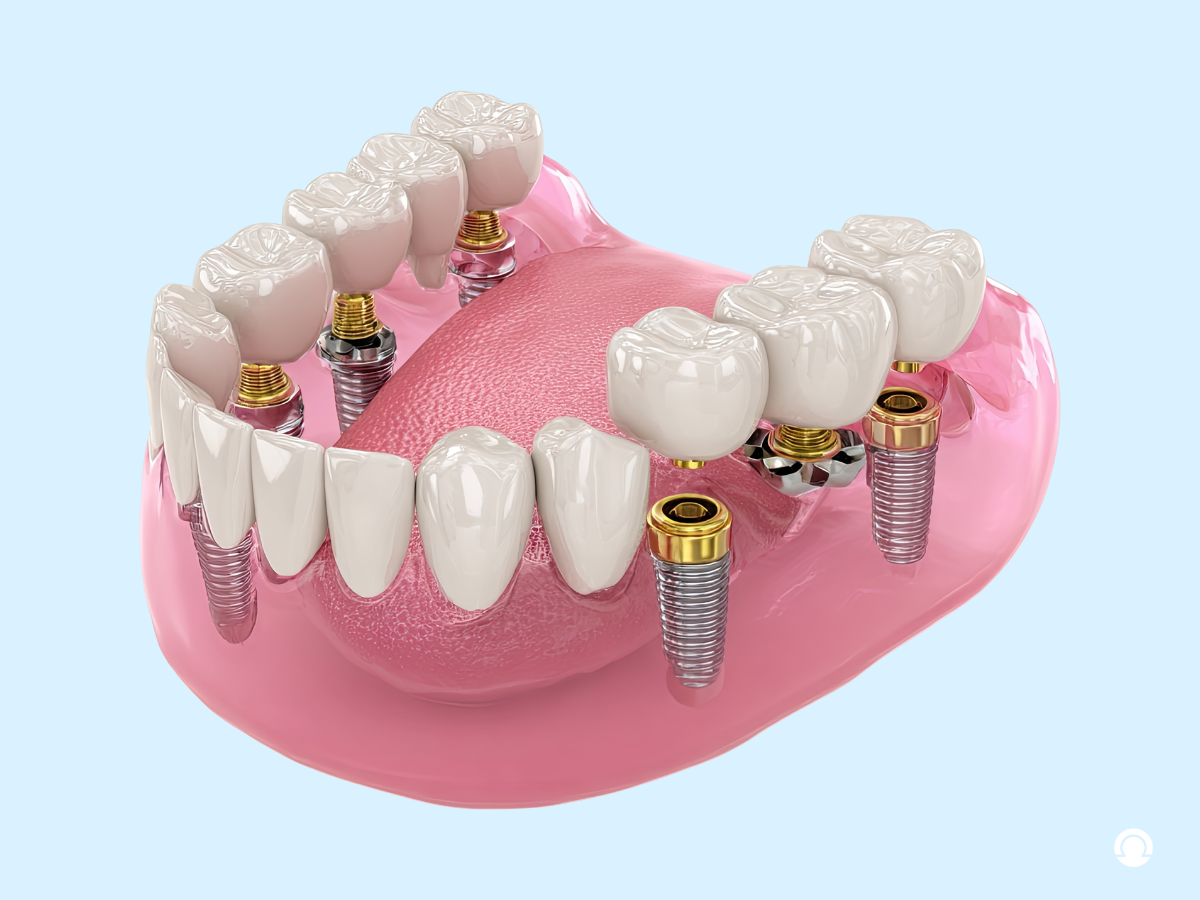
Missing a few teeth in a row? You don’t necessarily need a separate implant for each one. In a lot of cases, our surgeons can place two or three implants and use them to anchor a bridge that spans the whole gap. You still get a fixed, permanent result — it just costs less and means less time in the surgical chair.
This is one of those situations where the treatment plan really depends on the specifics. How many teeth are missing, where they are in your mouth, what the bone looks like in that area. It’s exactly the kind of thing we figure out during the consultation using our 3D imaging.
All-on-4 Dental Implants: A Full Arch in One Day
All-on-4 is probably the procedure that gets the biggest reaction from patients, because the results are dramatic and the timeline is fast.
Here’s the concept: instead of placing an implant for every single missing tooth, the surgeon places four implants at specific angles in the jaw — two toward the front and two tilted in the back. Those four posts are enough to support an entire arch of fixed teeth. The angled placement in the back is key because it grabs onto the denser bone that’s usually still there, even in patients who’ve already lost significant bone elsewhere. That means a lot of people who thought they weren’t candidates for implants actually are.
The part that surprises most patients? You walk out with teeth the same day. The surgeon places the implants, and a temporary set of teeth gets attached to them right there in the office. You go to dinner that night with a full smile. (We call this “teeth in a day” and we’ve seen grown adults tear up when they see themselves in the mirror afterward.) The permanent set gets fabricated and placed a few months later once everything has healed.
At Omega Dental Specialists, our board-certified oral surgeons use 3D CBCT imaging to plan every All-on-4 case. The scan shows the exact shape and density of your jawbone, so the implant positions are mapped out before you ever sit in the surgical chair.
Who All-on-4 works best for: Patients who’ve lost all or most of their teeth on an arch. Patients wearing dentures who are fed up with the slipping, the adhesive, and the food restrictions. And patients who’ve been told by another dentist that they don’t have enough bone for regular implants — the angled placement often makes All-on-4 possible even then.
What All-on-4 costs in Houston: Expect to start around $25,000 per arch. That covers the implants, the temporary teeth you leave with on surgery day, and the final permanent restoration. We offer financing through CareCredit and in-house payment plans, and a lot of patients are surprised at how manageable the monthly payments end up being.
How long it lasts: The titanium implants themselves? Those can last your entire life. The prosthetic arch on top typically lasts 15 to 20 years before it needs to be remade.
Full Mouth Dental Implants: When Both Arches Need Restoration
When both the upper and lower jaw need a complete rebuild, that’s a full mouth reconstruction. This is the big one — and it’s also the procedure that changes people’s lives in ways they didn’t expect. Patients tell us they eat foods they gave up years ago, they stop avoiding social situations, they smile without thinking about it.
The specific approach depends on you. Some patients get All-on-4 on both arches. Others need six or eight implants per arch because their bone density isn’t the same top and bottom, or because their bite requires more support. There’s no one-size-fits-all protocol, which is exactly why the planning stage matters so much.
We start every full mouth case with a CBCT scan — it builds a three-dimensional map of your jaw so our surgeons know precisely what they’re working with. Bone thickness, nerve locations, sinus position — all of it factors into the plan. It’s the difference between guessing and knowing.
What full mouth dental implants cost in Houston: You’re looking at $50,000 to $90,000 for both arches, depending on how many implants are needed, the type of prosthesis, and whether you require additional procedures like bone grafting or a sinus lift. We give every patient a line-item estimate before any treatment starts — we don’t like financial surprises any more than you do.
Implant-Supported Dentures: The Middle Ground
Maybe you’re not ready for the full commitment of All-on-4, or maybe the budget isn’t there right now. Implant-supported dentures are a really smart in-between option, and frankly, they don’t get talked about enough.
The way these work: we place two to four implants in your jaw, and your denture clips onto them using small attachment points. You still take the denture out for cleaning at night, but while it’s in, it is locked in. You can eat a steak. You can laugh without worrying. You can stop buying denture adhesive — that alone makes some patients happy.
This option is especially popular with people who already have traditional dentures and can’t stand how they fit. And because the implants are stimulating the jawbone, you actually slow down the bone loss that’s been making your current dentures fit worse every year. It’s sort of a two-for-one benefit.
What implant-supported dentures cost in Houston: Typically $8,000 to $15,000 per arch, depending on how many implants are placed and which attachment system we use.
Traditional Dentures: Still a Viable Option
Let’s be straightforward about dentures: they’re not what they used to be, and they absolutely still have a place. Modern dentures are custom-made from high-quality acrylic and composite materials, and when they’re done well, they look remarkably natural.
Full dentures replace a whole arch and sit on the gums. Upper dentures rely on suction to stay put, and they tend to be more stable. Lower dentures are trickier — they sit on the ridge of your lower jaw with mostly gravity holding them there, and that’s where a lot of patients run into frustration. Partial dentures are for patients who still have some natural teeth remaining, and they anchor to those teeth with clasps or attachments.
Now, the trade-offs. Dentures don’t stimulate the jawbone the way implants do, so bone loss keeps progressing. Over a few years, the fit gets looser and you’ll need relining or eventually a whole new set. Lower dentures in particular can be a daily annoyance for some patients. We always want to be upfront about that.
But here’s the thing — for a lot of patients, dentures are the right starting point. They get you functional teeth quickly and affordably, and they don’t close any doors. You can always upgrade to implant-supported dentures or All-on-4 down the road when the timing is better.
What dentures cost in Houston: A quality set of custom dentures runs between $1,500 and $5,000 per arch, depending on the materials.
Who dentures work best for: Patients who need something now and need to keep costs down. Patients who want to restore basic function while they plan for something more permanent later.
Dental Bridges: Filling the Gap Without Surgery
A bridge does pretty much what the name suggests — it spans the gap where one to three teeth used to be. The false teeth (pontics, in dental speak) are fused to crowns that get cemented onto the natural teeth on either side.
Bridges have been around for decades and they work well. They’re fixed in your mouth, you don’t take them out, and they look and function like real teeth. The catch is that those anchor teeth on either side have to be filed down to fit the crowns, and once you do that, there’s no undoing it. You’ve permanently altered healthy teeth.
For patients who have strong teeth flanking the gap and want to avoid surgery, a bridge is a solid option. It’s just worth understanding the trade-off going in.
What bridges cost in Houston: Typically $2,000 to $5,000, depending on how many teeth are being replaced and the materials involved.
Who bridges work best for: Patients missing one to three teeth in a row who have healthy teeth on both sides and would rather not go through an implant surgery.
How to Choose the Right Option: A Practical Framework
With all these choices laid out, here’s how we’d suggest thinking through it:
Missing one tooth with good bone health? A single implant. It protects the bone, leaves your other teeth alone, and you’ll probably never think about it again.
Missing a few teeth next to each other? An implant-supported bridge. Fewer implants, lower cost, still permanent.
Missing all your teeth and want them fixed in place? All-on-4 or full mouth implants. These are the procedures patients describe as life-changing, and that’s not an exaggeration — we’ve watched people completely transform after getting them done.
Working with a tight budget? Traditional dentures are a completely reasonable place to start. Get functional teeth now, and transition to something implant-supported when you’re ready. There’s no rush and no judgment.
Wearing dentures that you’re sick of? Talk to us about implant-supported dentures or All-on-4. We hear the same thing from patients who switch over: “I wish I’d done this years ago.”
Why Houston Patients Choose Omega Dental Specialists
We built Omega Dental Specialists around one idea that seemed obvious but turns out to be pretty rare: put all the specialists in one place. Board-certified oral surgeons, periodontists, prosthodontists, and general dentists — all under the same roof on West Gray Street in Midtown. That means you’re not getting bounced between three different offices across Houston for one treatment. Your surgeon, your restorative dentist, and the rest of the team are all down the hall from each other, talking about your case together.
Every implant patient gets a 3D CBCT scan for planning. We do same-day procedures when the case allows it. We have sedation options for patients who need them. Our team speaks both English and Spanish. And we’re transparent about pricing — you get a detailed estimate before treatment, plus financing through CareCredit and in-house payment plans if you need them.
We’ve earned over 1,300 five-star Google reviews from patients across the Houston area — Montrose, the Heights, River Oaks, the Galleria, Bellaire, West University, Katy, Sugar Land, Pearland, The Woodlands — and the thing most of those reviews mention is that the experience was nothing like what they expected from a dental office. We take that as a compliment.
Take the First Step: Free Consultation
Everything starts with a conversation. When you come in for your free consultation at Omega Dental Specialists, we’ll take a look at what’s going on, get any imaging we need, and walk through the options that actually make sense for you — with clear pricing and a realistic timeline.
You don’t have to keep living with missing teeth. Give us a call at (713) 322-7474 or book your free consultation online. We’re at 106 W Gray St in Midtown Houston, TX 77019, and we see patients from all over the Greater Houston area — Montrose, the Heights, River Oaks, the Galleria, Bellaire, West University, Katy, Sugar Land, Pearland, and The Woodlands.